Pint Sized Powerhouse a speaker collab between Toid and Zarbo
Home / Forums / DIY Audio – DIY Speaker, DIY Subwoofer anything DIY Audio related / Pint Sized Powerhouse a speaker collab between Toid and Zarbo
Tagged: pint sized powerhouse
- This topic has 6 replies, 3 voices, and was last updated 1 year, 8 months ago by
 UnknownSpectre.
-
AuthorPosts
-
-
 August 23, 2023 at 5:06 am #42160
I wanted to start a thread on the Pint Sized Powerhouse. I know there are a lot of interesting things going on with this and thought I could help clarify.
Why?
I have been hounding Zarbo about a collaboration for a while now and he finally broke down and said yes. He even had a speaker idea in mind. When he was younger he always wanted a pair of the Design Acoustics PS-8. Unfortunately back then they were out of his price range. So we decided to spice it up, create a speaker that not only is more affordable, but includes technology that can make it sound better as well.
Check out his video where he talks all about it and goes over the box build:
What is it?
The original PS-8 were a 3 way speaker with a downfiring subwoofer in a fairly small box. We wanted to keep these same design goals, but update it.
Parts Chosen and Why
Tweeter: https://parts-express.sjv.io/Qy6vAP
Midrange: https://parts-express.sjv.io/LXZy4j
Subwoofer: https://parts-express.sjv.io/Py6vRz
Amplifier: https://parts-express.sjv.io/k0o19z
Port: https://parts-express.sjv.io/e43ZPQ
We really wanted these put out a lot of bass, but still stay in a nice and compact size like the PS-8 originally were. But instead of using an 8″ subwoofer, we thought we could/should bump it up to a 10″ subwoofer. GRS recently came out with their new high excursion subwoofers. These not only have the potential for a lot of bass, but also, with the use of DSP, can play low without the need of a large box. This was perfect for our application.
As far as the midrange went, we wanted a 4″ midrange that also could play well with relatively low distortion. After looking around, we settled on these, which include a copper shortening ring. This is designed to keep distortion down.
Finally, the tweeter is one Tom really wanted to use for this build. It was able to crossover low enough for the midwoofer and has a fairly flat response, which should help with getting a fairly flat response in the end, without much use of DSP. (should being the magic word).
Hybrid Speaker
We’ve talked about updating these and we really wanted to do this with the use of DSP. After looking around we choose this 4 channel amplifier from Dayton Audio. This amplifier has 4 channels of output with DSP built-in using the very powerful Sigma Studios. With the 4 channels of amplification, that means we now have the ability to have each speaker have their own powered subwoofer!
This has a few advantages. First we can turn up and down the bass as much as we desire. And second, we don’t have to match the midrange and tweeter sensitivity to the subwoofer. Which is really key, as a normal 3-way the sensitivity would be whatever the subwoofers sensitivity is (which is low). IE you will need a lot more power to power the system.
Unfortunately, this amplifier only has 4 outputs, meaning we can power the subwoofer on each speaker (that takes up 2 channels) meaning the other two channels have to power both the midrange and tweeter in each speaker. IE, we can’t had a digital crossover, as both the mdi and tweeter have to run off one amplifier channel. In order to do a full DSP with no passive crossover, we would have need 6 channels (one for each driver).
Hence the hybrid system. This will employ a passive crossover that will crossover the midrange and the tweeter. Everything else will be active. That means, we will employ a digital highpass to protect the subwoofer, a digital crossover between the subwoofer and the midrange as well as some really neat DSP that will make this speaker truly amazing. But that is enough for now.
-
This topic was modified 2 years, 6 months ago by
 Toids_DIY_Audio.
-
This topic was modified 2 years, 6 months ago by
-
August 23, 2023 at 5:07 am #42162
Passive Crossover Response
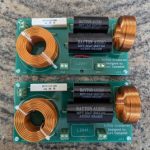
Before I did anything, I wanted to get some measurements of both drivers in the beautiful cabinet that Tom built. He really did an amazing job with these! I went ahead and mounted both the midrange and the tweeter. and wired them out the rear port. Which is a trick that many speaker builder use when designing a crossover. This allows you to work on the crossover outside the box, before you decide on the exact crossover.
I would love to tell you I only did the crossover once, but that would be a lie. The first preliminary crossover, was a little off in it’s phase relationship. Not by much, but it was measurable when you went off axis. Basically, when I went off axis, you could see some slight variations at the crossover region which is not ideal. And although, this was barely out of phase and probably good enough for most people. I really wanted perfect phase alignment.
So after working some more on it. I can up with a third order crossover on the tweeter, that would help get rid of unwanted distortion, making it play louder, cleaner and take more power. On the mid, I only needed a second order. The high end of the tweeter did rise, but I knew we could take care of that later with DSP, so I wasn’t worried about it. This was the final response with just the passive crossover.
Distortion
When playing the midrange by itself without the subwoofer, it did sound strained. Now we were already planning to cross it over with the sub, but knowing exactly where can be problematic for some people. Especially a downfiring sub. But one measurement that can really help with that is a distortion measurement. With the distortion measurement taken, I pay close attention to the odd harmonic distortions. In this case, the distortion was really problematic after about 150hz. This gave us good insight into where we needed to cross it over.
DSP
Now was the time to work some magic. First thing I wanted to do was flatten the response to as close to +/- 1 db as possible. For this I had to use a trick that Elliott Designs taught me. Basically, the drivers response isn’t linear in part to it’s phase that is interacting with the materials and design of the driver itself. In order to make that linear, we take some measurements in REW, import those measurements to a program called rephase and then import the final fix to Sigma Studios. It sounds like a lot and it is. So I will leave you with Elliott’s Videos, so you can watch them yourself.
One this you will want to know is that when Elliott is talking about taps, the KABD-4100 can only do 500 taps total. Since there are two speakers, that means no more than 250 each and in our case, it was closer to 225. In the end with linear phase and a little EQ we got a truly flat response. What is crazy, is it is actually a little flatter than it looks.\
In this build we have three potentiometers, one that changes the bass volume, treble volume and one for the main volume. It appears in this measurement I had the treble turned down about a 1/2 dB. Whoops.
-
This reply was modified 2 years, 6 months ago by Toids_DIY_Audio.
-
This reply was modified 2 years, 6 months ago by
-
August 23, 2023 at 5:07 am #42163
Tonight I wanted to work on 3d printed enclosure for the Pint Sized Powerhouse. There are a lot of wires that go in there! So I decided to zip tie them together as best as I could. I think I am going to redo this enclosure one last time, because I was getting some artifacts that I am not happy with. Also I might have screwed the screws right through the bottom of the enclosure! Whoops! SP I think I will raise them just a little bit more. The only thing I still have to hook up is the speaker wire. I haven’t done that yet, because I am not sure which is right and which is left. So I need to hook it back up and test it out.
-
This reply was modified 2 years, 6 months ago by Toids_DIY_Audio.
-
This reply was modified 2 years, 6 months ago by
-
-
August 24, 2023 at 8:09 pm #42243
The amplifier case is complete. Now I just need to verify the center of the potentiometers and put on the binding posts. Should be finished anytime now.
-
-
 June 11, 2024 at 1:02 am #54132
Interestingly enough, I have found a pair of PS-8a for sale near Easton PA. Marked down to $85 if you want an A-B comparison.
-

-
-
AuthorPosts
- You must be logged in to reply to this topic.